

Built For
Instruments: Stocks
Trading Style: Day Trading
Strategy Overview
This strategy focuses on short-selling euphoric small-cap runners during the exhaustion phase of a multi-day move.
The core edge comes from identifying “mini bubbles” — short-term parabolic advances fueled by momentum, retail participation, and emotional buying — and entering when that upward pressure begins to fail.
Unlike long breakout trading (low win rate, high R:R), this strategy prioritizes:
- Higher win rate
- Defined structural invalidation
- Psychological inflection points
- Controlled scaling by setup quality
Primary Setup: First Red Day (FRD)
Secondary Setup: Parabolic Short (Intraday Compression of FRD)
Core Philosophy
The best signal that a stock is ready to go down is when it can no longer continue going up.
The strategy is built around:
- Euphoria exhaustion
- Psychological shift from green to red
- Trapped late buyers
- Momentum failure after acceleration
Small caps produce these bubbles weekly — unlike macro bubbles that occur once every decade.
Strategy Setups
Setup 1: First Red Day Strategy (Primary Setup)
The First Red Day is not simply “a red candle.” It is the first meaningful breakdown after a clean, extended, multi-day euphoric run. The move must qualify as a bubble.
Minimum Criteria (Non-Negotiable)
Before considering the trade, all of the following must be present:
- Minimum 2–3 consecutive green days
- 80–100%+ extension from the start of the run
- Expanding daily volume
- Expanding daily range (acceleration)
If these are not met, it is not the setup.
Ideal Characteristics (Higher Grade Factors)
The best FRD setups show:
- Daily candles increasing in size as price rises
- Volume building into the top
- No red days during the run
- Parabolic curvature (acceleration phase)
- Blow-off top day with oversized range
- Large upper wick on the top day
- Clean structure without chop
Red Flags (Downgrade Factors)
- Shrinking candles into highs
- Declining volume
- Choppy multi-red-day structure
- Frequent halts
- Slow accumulation instead of an explosive run
Why Multiple Green Days Matter
More green days = more longs entering at elevated prices.
When the stock finally goes red versus the previous close:
- More traders become instantly underwater
- Fear replaces euphoria
- SSR triggers after -10%
- Selling pressure becomes real
If the run had no prior red days, the psychological shift is cleaner.
The Importance of Previous Day’s Close
The previous day’s close is the most important level. Retail traders determine profit/loss based on green or red versus prior close — not opening price.
A stock can gap up, sell off heavily, and still appear green on the day. The true shift occurs when price breaks below the previous close. That is the psychological trigger.
Entry Methods (From Aggressive to Conservative)
Pre-Red Entry (Highest R:R, Lower Win Rate)
- Short before price breaks prior close
- Looking for failure to make new highs
- Risk: All-time high of run
Best reward, more stop-outs.
Standard Entry (Break of Previous Close)
- Wait for the crack below prior close
- Add on failed bounces
- Risk: Today’s high of day
Most balanced approach.
Lower High Confirmation
- Wait for the breakdown
- Wait for the first bounce
- Short failed lower high
Higher win rate, worse R:R.
Exit Rules
- Cover into weakness
- Do not wait for the exact bottom
- Small caps: target minimum -10% on day
- Larger assets: 2–3%
- Use VWAP as a general magnet for parabolics
- Scale out, avoid all-or-nothing
Optional: Trail using 15-minute high.
Setup 2: Parabolic Short Strategy (Intraday Version)
An intraday bubble where the price accelerates into a clear parabola. Not a spike.
True Parabolic Characteristics
- Gradual build
- Multiple green candles
- Pullbacks shrinking
- Volume increasing into top
- Curving structure
Not a Parabolic
- One-candle news spike
- No build
- Random volume pop
- Sideways then vertical move
Entry Methods
Aggressive
- Watch the tape for velocity slowdown
- First major volume contraction
- Risk: High of the day
Safer
- Wait for a pullback
- Short first lower high
- Risk: All-time high
Target
VWAP is the primary magnet. Cover before perfect bottom.
Maximum Attempts Rule
Hard rule: 3–5 attempts maximum. Over-attempting destroys mental and financial capital.
Setup 3: Overextended Gap Down Variation
After multiple consecutive gap ups:
- The first gap down is significant
- Do not short if already down 10%+
- Wait for bounce to improve R:R
- Risk: Prior close
Risk Management
Primary stop level: the all-time high of the run. If the price continues making new highs, the thesis is invalid.
Tighter stops can be used after confirmation, but increase the chance of being prematurely stopped. Avoid entering new positions late in the day. Gap risk is real.
Common Mistakes
- Calling any red day FRD
- Ignoring volume
- Shorting spikes instead of parabolics
- Overtrading C setups
- Getting exhausted before A+
- Not tracking setup grade performance
- Shorting strong fundamental runners too early
- Using the opening price instead of the prior close
Trade Breakdown
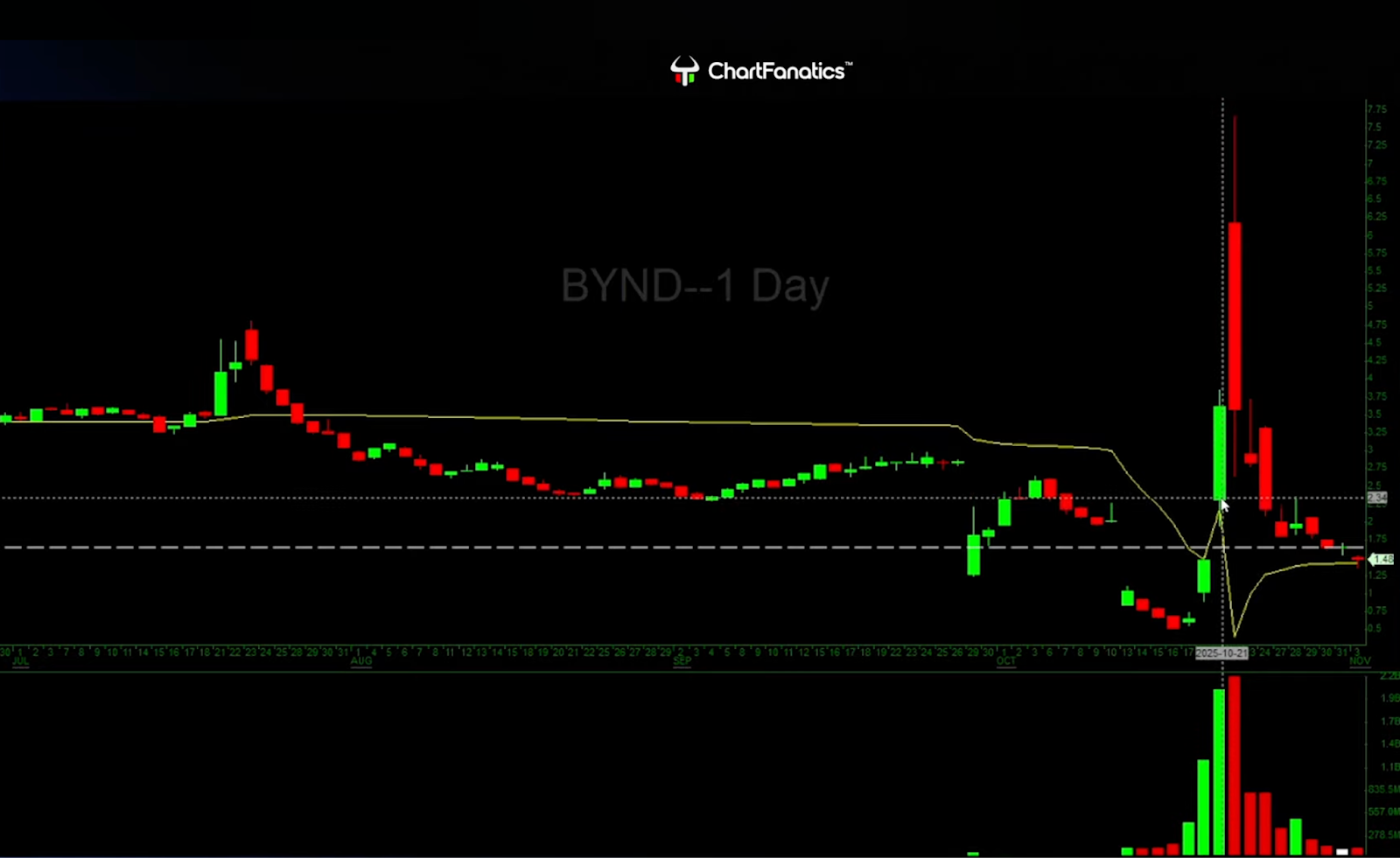
BYND – A+ First Red Day
Daily Setup
BYND completed a multi-day euphoric run.
- Price advanced from approximately $0.50 to $7.70
- Extension exceeded 1,400%
- Volume expanded aggressively into the highs
- Daily ranges increased into the final push
- The top day showed blow-off characteristics
The structure met all First Red Day minimum criteria and was graded as A+.
Confirmation
After several consecutive green days, the price failed to continue making new highs.
The key confirmation occurred when:
- Momentum stalled near highs
- Price broke below the previous day’s close
That break marked the first meaningful shift from expansion to weakness. The previous day’s close acted as the psychological inflection point.
Entry
A short was taken on the break below the previous day’s close. Risk was defined against the high of the run.
If price reclaimed new highs, the thesis would be invalid.
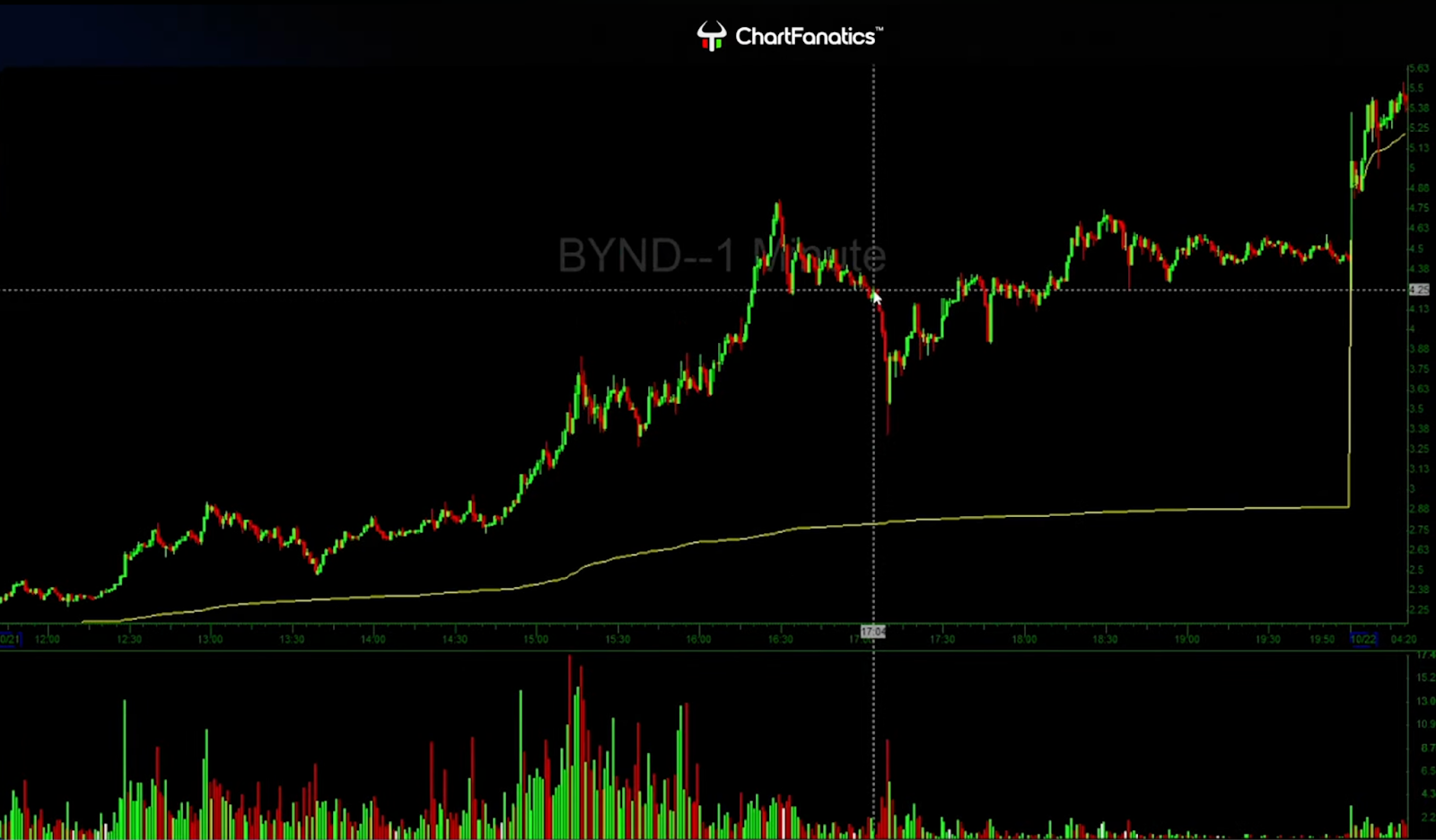
Intraday Development
Once red on the day:
- Selling pressure increased
- Bounces failed to reclaim resistance
- Lower highs began forming
The transition from momentum buying to distribution was clear. Additional size could be added on failed bounces with defined risk.
Exit
Partial covers were taken into weakness. The objective was to capture the unwind phase rather than predict the absolute bottom.
The trade produced a significant profit as the euphoric move reversed.

Test this strategy free on NinjaTrader before you risk a dollar
14 days free simulated trading trial. Practice your edge without risking your capital.



.svg)


.svg)
